
Commercial plumbing is plumbing work on a business building: kitchens, washrooms, drains, hot water plant and gas, plus backflow and thermostatic mixing valve testing. Call us when a business site needs that work done by a licensed plumbing contractor, WA licence PL 9348, from a blocked floor drain to a fit-out or a backflow test.
Ashley Woolf's team at Woolf Plumbing & Gas comes from Forrestdale and works across Perth, from Alkimos to Dawesville. That includes the Perth CBD. We work with business owners and property managers. We've worked in medical clinics and restaurant kitchens. Warehouses, apartment buildings and schools too.
Ring (08) 6555 7757 or send the quote form with the kind of site and the job. For a backflow device, tell us where it sits and when it was last tested.
What counts as commercial plumbing
It's the same trade as at home, with different buildings and different rules. These are the kinds of site and work we've done.
Kitchens. Gas pipework and appliances in restaurant kitchens, blocked floor drains in commercial kitchens, kitchen sinks with new waste pipework, and a boiling water unit in a staff kitchen.
Washrooms and clinics. Blocked toilets and floor drains, a new toilet suite, a toilet cistern repair, and basins and mixers in commercial washrooms.
Warehouses and workshops. Fit-out pipework along warehouse walls, floor wastes, a copper gas line in a workshop, and under-floor drainage laid in the reinforcing mesh before a slab pour.
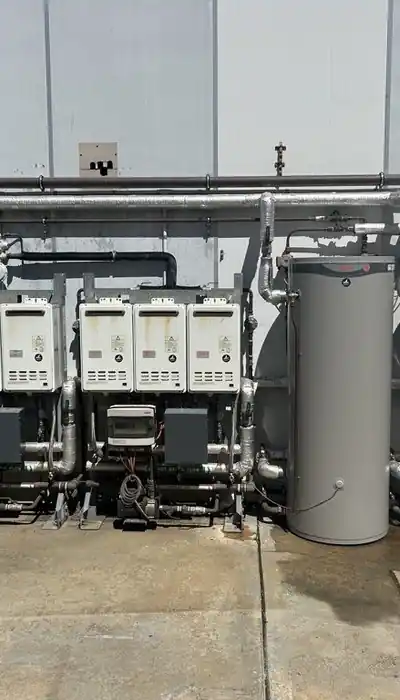
Hot water plant and apartment buildings. A bank of commercial gas water heaters on a shared manifold with circulation pumps. Circulation pumps and lagged pipework in an apartment car park. Work in service cupboards and risers.
Car parks and basements. A backflow device beside a commercial car park, and suspended sewer stack pipework in a commercial basement ceiling.
Which properties need backflow testing, and how often?
Properties rated high or medium risk, and fire services, have testable backflow devices at the boundary. Water Corporation says those devices must by law be tested when they're commissioned, after any maintenance and every 12 months, by an accredited tester qualified to test them. It sends the property owner a reminder for boundary devices.
Maintenance is a different matter. Water Corporation says an accredited tester may test a device, but only a licensed plumbing contractor may maintain it, and an owner or occupier who fails to maintain one is served a non-compliance notice. Our plumbing contractor licence is PL 9348.
We also hold backflow licence BF 2890. To test a device we put gauge hoses on its test points and read a differential pressure test gauge. We fit new devices too. AS/NZS 2845.3 is the standard for field testing and maintenance of backflow devices.
How we work on a commercial site
Gas in a kitchen. We strip the wall back to the pipework, run new copper line, fit isolation valves and a regulator, connect the appliances on braided hoses and check the height of the line. Then we pressure test at the meter with a digital manometer. We're a licensed gas fitter, WA licence GF 14901.
Drains. A drop sheet or floor sheet goes down, then the cable or hose goes into the floor drain. In a commercial washroom a wet floor sign goes out while we clear drains.
Protecting the site. We've laid plastic sheeting over an apartment floor and a mat down in clinic rooms.
Recent commercial jobs
Hamilton Hill, July 2026. A medical clinic had a blocked toilet and a blocked floor drain. One of our plumbers fed a drain machine cable into the floor drain beside the toilet, then into the toilet outlet.
Scarborough, March 2026. A backflow device at a commercial site. We tested it with a differential pressure test gauge.
Willagee, February 2026. We tested a large backflow assembly with a differential pressure test gauge.
Forrestdale, February 2026. Fit-out pipework in a warehouse. We ran new PVC drainage and copper pipework along the base of a concrete wall.
Rockingham, April to July 2025. Gas work in a restaurant kitchen. We removed the old wok range, ran new copper gas line along the stripped wall and fitted new wok burners. A four-burner commercial cooktop went in beside the wok range, with a gas bayonet outlet on the dining room wall.
Where we do it
The jobs above sit in North of the river, South of the river and Rockingham and Peel.
Other services for a business site
Commercial kitchens and washrooms bring drain trouble, so see Blocked Drains. A restaurant kitchen's gas work sits under Gas Plumbing. Hot Water is the page for heaters and storage units. We've worked on commercial gas heaters too. For an emergency, our Emergency Plumber service is 24/7.
Frequently asked questions
Do you test thermostatic mixing valves as well?
Yes. Thermostatic mixing valve testing is part of our commercial plumbing service, alongside backflow testing. Ring or send the quote form and tell us what is on your site.
What does commercial plumbing cost?
It depends on the job. We quote each one. Ring (08) 6555 7757 or send the quote form with the kind of site, the work you need and where it is.
Is there help if something fails after hours?
For an emergency, yes. Our emergency plumbing is 24/7. For anything else, tell us what you need when you ring or send the quote form and we'll go through it with you.
Who is responsible for backflow testing, the owner or the occupier?
The property owner or occupier. Water Corporation says installing a backflow device, and testing and maintaining it from then on, is their responsibility.
How soon does a backflow test report have to be lodged?
Within 5 working days. Water Corporation says backflow test reports must be submitted online no later than 5 working days after the test.
How is a property's backflow risk rated?
As low, medium or high under AS/NZS 3500.1, Water Corporation says. What happens on the site decides the final rating, and some commercial and industrial processes can put a property at high risk by default. Fire services are rated medium whatever their size.
Can a backflow device be buried?
No. Water Corporation says a backflow prevention device must stay accessible for maintenance and testing, and must not be buried.
